Uncategorized

Root Canal Vs. Dental Implant: What’s The Difference?

Two of the most common options for dental procedures are root canals and dental implants. While both serve different purposes, they are often compared to each other as they deal with issues related to the tooth’s health. This post will discuss the differences between the two procedures, helping you understand which option is best for… Continue Reading Root Canal Vs. Dental Implant: What’s The Difference?

Smiling dentist with long dark hair in navy scrubs
Dr. Azy Nasiry
Dentist
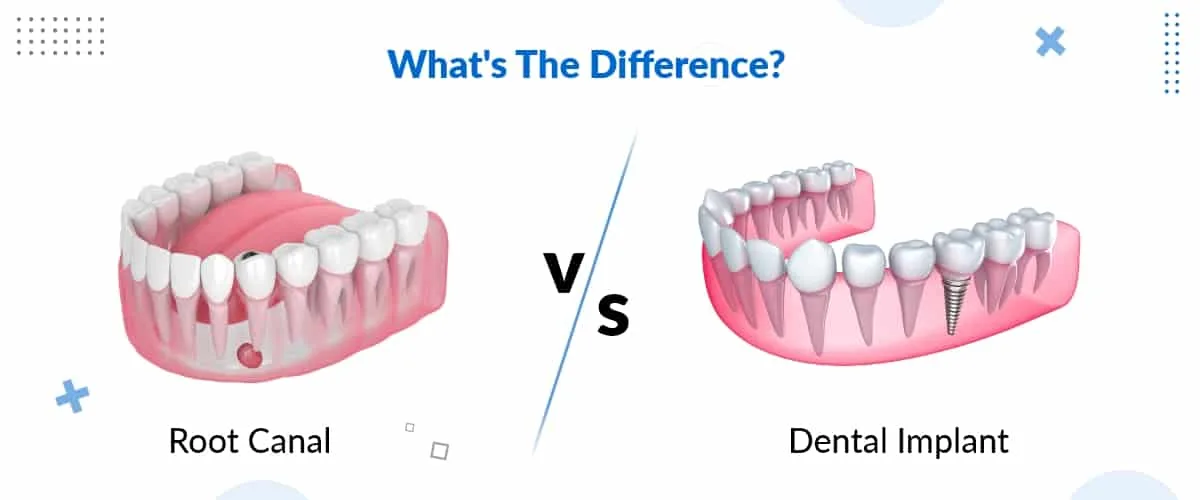
Two dental models side by side, one with a root canal treated tooth and one with a dental implant, under the title What's The Difference?
Smiling dentist with long dark hair in navy scrubs
Dr. Azy Nasiry
Dentist
Dr. Azy Nasiry is a cosmetic dentist at LA Dental Clinic in Los Angeles and a UCLA faculty member who teaches advanced cosmetic dentistry to practising dentists. She holds a Biomimetic Mastership from the Alleman Center, a certification held by only a small number of dentists in the United States, and developed the layered composite edge bonding technique the practice is known for. She has been treating patients in Los Angeles since 2008 and co-hosts the Smile Sisters Podcast.
Share Article:
Two of the most common options for dental procedures are root canals and dental implants. While both serve different purposes, they are often compared to each other as they deal with issues related to the tooth’s health. This post will discuss the differences between the two procedures, helping you understand which option is best for you to help you achieve your best smile.

Purpose

The primary purpose of a root canal is to save a damaged or infected tooth from extraction. It involves removing the infected or damaged pulp from the tooth’s interior and replacing it with a filling. On the other hand, a dental implant is a prosthetic tooth that replaces a missing or extracted tooth. A prosthetic tooth is attached to a metal post that has been surgically implanted into the jawbone. The reason the two procedures are usually compared is that sometimes, the cost of doing a root canal and saving a tooth may not be worth it if the tooth is severely decayed, damaged or if it has had previous root canal treatment.  These teeth have what is called a “poor prognosis” meaning that the chances of the tooth lasting for more than 5 years is low.  In these cases, it is sometimes better to remove the tooth and replace it with an implant that has a higher chance of being successful and work for you for years to come.

Procedure

A root canal is a relatively simple procedure that can be done in one or two visits to the dentist. After numbing the area, the dentist will make an opening in the tooth and remove the infected or damaged pulp. They will then clean the interior of the tooth and fill it with a filling material. Finally, they will seal the opening with a temporary filling till a permanent crown can be placed on the tooth. The permanent crown or filling is a crucial step in making sure your tooth will have a high chance of surviving for years ahead.  One of the most common reasons root canals fail is that there is no final crown placed on the tooth and the tooth becomes reinfected.  Then it goes into the “poor prognosis” bucket. In contrast, there are multiple processes involved in installing a dental implant, including inserting the metal post into the jawbone, allowing it to fuse with the bone, and affixing the replacement tooth. Several trips to the dentist are required throughout this process, which can take many months.

Cost

The extent of the infection and the tooth’s location both affect how much a root canal procedure costs. But generally speaking, it is less costly than a dental implant. Due to the complexity of the procedure and the materials used, dental implants are more expensive. Additionally, while root canals are typically covered by insurance, a dental implant may not be entirely covered.

Longevity

Both Root canals and dental implants can last a lifetime.  For root canals, it is important to finish the process and get a final crown or filling placed on the tooth.  As mentioned above, having root canals with a temporary filling for years is a top reason why root canals fail and become reinfected.   For Dental implants, overall oral and general health is very important.  Dental implants cannot get cavities, but they can have bone loss just like other teeth.  Regular maintenance is important for both types of restorations to last a lifetime.

Recovery Time

The recovery time for a root canal is relatively short, with most patients returning to normal activities the same day. However, some sensitivity and discomfort may be experienced for a few days after the procedure.  recovery time for a dental implant can be several days after surgery.  Also, a period of several months must pass before a final crown is placed  as the post fuses with the jawbone. During this time, a temporary tooth may be worn until the replacement tooth is attached.

Oral Health

Both root canals and dental implants can improve oral health. Root canals remove infected or damaged pulp from the tooth, preventing the spread of infection and saving the tooth from extraction. Dental implants replace missing or extracted teeth, preventing bone loss and preserving the integrity of the jawbone. However, proper oral hygiene is essential for both procedures to maintain oral health.  If you have a tooth with an infection, it is never a good idea to leave it in your mouth because your body has to constantly fight an active infection.  Removing the tooth or starting a root canal are usually the two options when there is an infected tooth. Root canals and dental implants serve different purposes and have their own benefits and drawbacks. While a root canal can save a damaged or infected tooth from extraction, a dental implant replaces a missing or extracted tooth.  In some cases, it is more cost effective to remove a decayed tooth and replace it with an implant rather than try to save the tooth with a root canal.  These teeth have a “ poor  prognosis” because of how decayed they are, if they are broken,  or if they have had previous root canals that have failed in the past.   With dental implants being over 95% effective, dentistry is moving toward replacing teeth with poor prognosis whereas we used to try and save many of these teeth before dental implants were mainstream.   Both procedures can improve oral health, but the Prognosis, cost,, and longevity of the procedure should be considered when choosing the best option. Ultimately, it is best to consult with a dental professional to determine which procedure is right for you.

Related Articles

Gum Disease, Uncategorized
Patient with a plastic lip holder pulling her lips back to show the upper and lower teeth and gums

Gum Surgery

There may be many reasons for why a person may seek out gum surgery and gum tissue treatments. You may suffer from gum disease, recession, excess gum tissue, abscessing o...

Smiling dentist with long dark hair in navy scrubs
Dr. Azy Nasiry
Dentist
Uncategorized
Aligner case beside the title SureSmile vs Invisalign, Is There a Difference

Suresmile Vs. Invisalign: Is There A Difference?

Choosing between orthodontic treatments can be a pivotal decision, and many patients weigh their options between Suresmile and Invisalign. Both methods utilize clear alig...
Smiling dentist with long dark hair in navy scrubs
Dr. Azy Nasiry
Dentist
Uncategorized
Lower jaw model beside the title When Can You Smoke After Wisdom Tooth Extraction

When Can You Smoke After Wisdom Tooth Extraction?

Undergoing a wisdom tooth extraction can be a significant dental procedure that requires careful post-operative care to ensure a smooth and efficient healing process. One...
Smiling dentist with long dark hair in navy scrubs
Dr. Azy Nasiry
Dentist
Uncategorized
Retainer case beside the title How Long Should You Wear a Retainer After Invisalign Treatment

How Long Should You Wear a Retainer After Invisalign Treatment?

After completing your journey with Invisalign, it’s crucial to understand the next steps to ensure the longevity of your newly aligned smile. One of the most critic...
Smiling dentist with long dark hair in navy scrubs
Dr. Azy Nasiry
Dentist
Areas served:
Koreatown | Wilshire Center | Mid-Wilshire | Downtown Los Angeles | Westlake | Pico-Union | Hancock Park | East Hollywood | Larchmont | Hollywood | Los Feliz | Silver Lake | Echo Park | Miracle Mile | Beverly Grove | Beverly Hills
Subscribe
© 2026 LA Dental Clinic. All Rights Reserved

Be the first to know.

Special offers and exclusive savings from LA Dental Clinic, sent to you before anyone else hears about them.


By submitting this form, you agree to receive recurring automated marketing text messages from LA Dental Clinic at the number provided. Consent is not a condition of any purchase. Msg & data rates may apply. Msg frequency varies. Reply STOP to opt out or HELP for help. See our Privacy Policy.

Let's Work Together

Are you an influencer or content creator? We'd love to collaborate. Share your details below and our team will be in touch.
Social Platforms*
Are you based in LA?*
Dr. Azy Nasiry speaking with a patient on a video call during a virtual dental consultation

How Would You Like To Book Your Consultation?

We make it easy to get started. LA Dental Clinic offers both virtual and in-person consultations to fit your schedule. Please select your preferred option below.
Two dentists chatting on a gray sofa for the Smile Sisters podcast

Choose A Platform

Each week, Dr. Arezoo and Dr. Azy answer the questions patients ask most, covering everything from root canals and dental implants to the realities of a smile makeover and what it actually takes to get one right. More than forty episodes since 2024, available on Apple Podcasts, Spotify, and YouTube Music.